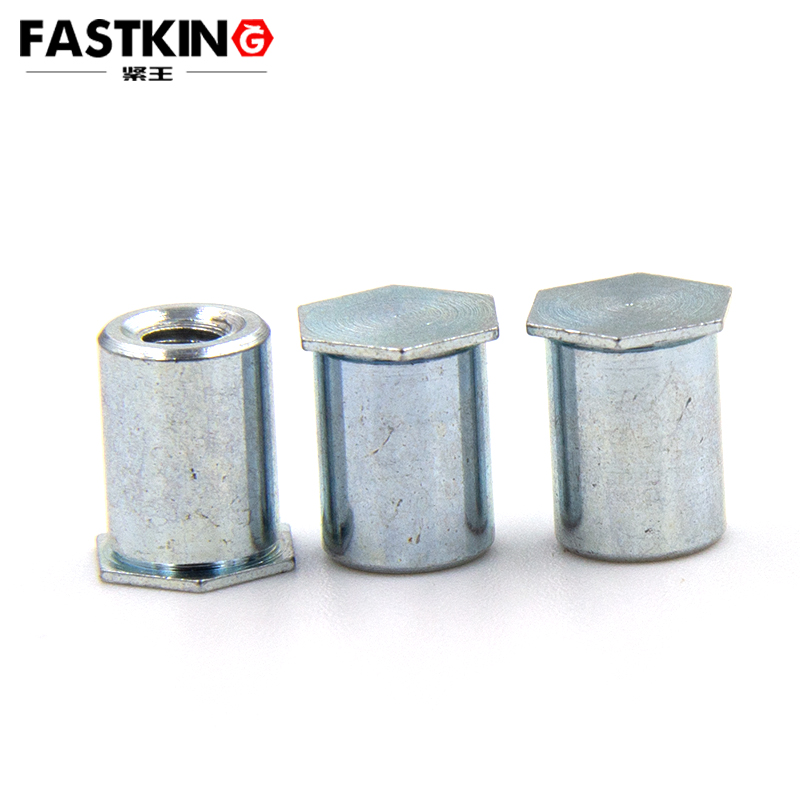
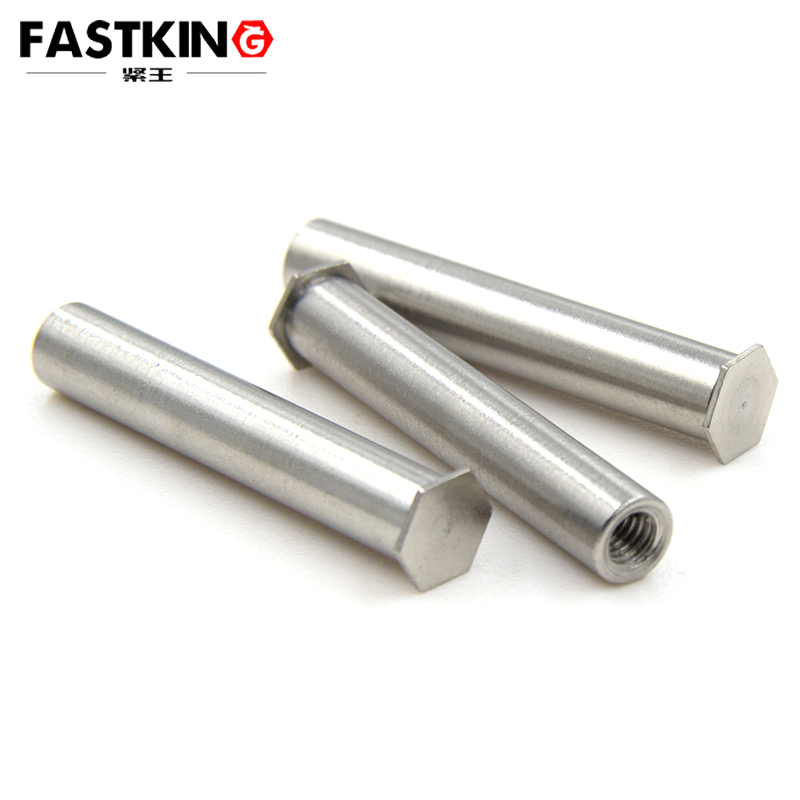
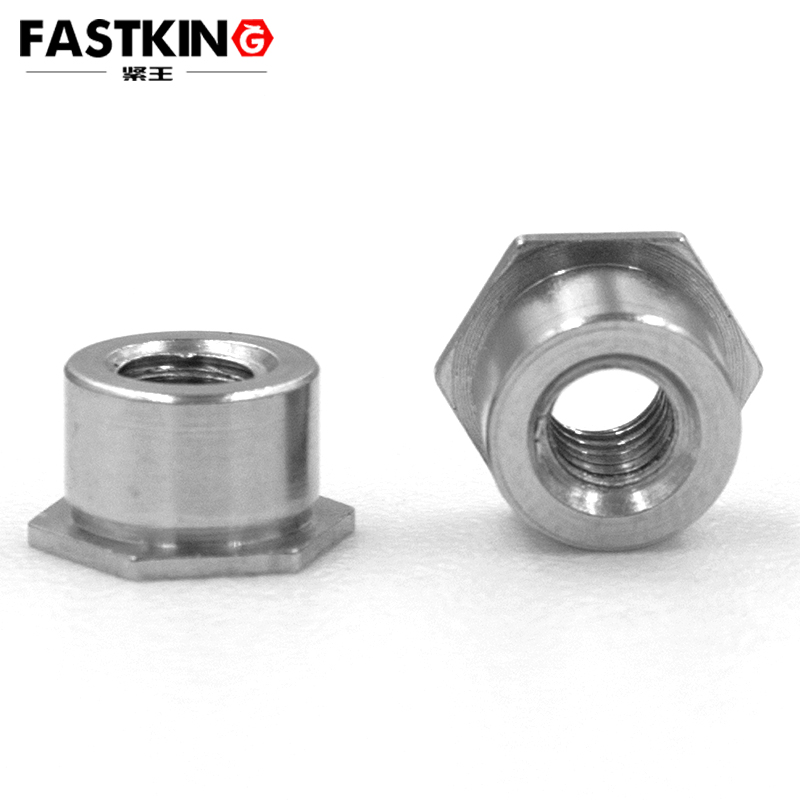
In precision assembly fields such as sheet metal processing and electronic equipment manufacturing, the selection of fasteners directly determines the structural stability, appearance integrity, and operational safety of products. As a key category among them, blind hole rivet studs, represented by two core models BSO and BSOS, have become indispensable core components in sheet metal or PCB (Printed Circuit Board) connection scenarios by virtue of their unique advantage of "one-side installation with no protrusion on the other side". They not only perfectly solve the technical problems of threaded connection and support spacing between sheet metals but also create an aesthetically pleasing and safe surface effect through their concealed installation feature, widely adapting to the stringent requirements of high-end manufacturing fields such as automotive electronics, consumer electronics, and aerospace.
The core definition of blind hole rivet studs lies in the combination of their "blind hole" installation attribute and riveting fastening principle. Different from traditional studs that require penetration through both sides of the workpiece for fixation, they are specifically tailored for scenarios requiring "one-side operation and a flat surface on the other side" — only one side of the mounting plate is needed to complete the riveting fixation, and there will be no exposed threads or protruding components on the other side. This design not only avoids problems such as surface unevenness and component interference that are prone to occur with traditional fasteners in sheet metal connections but also greatly expands their application range in enclosed spaces and precision structures. Whether it is the connection and fixation between sheet metals or the support spacing between PCB boards and metal casings, blind hole rivet studs can ensure connection strength while taking into account the aesthetic neatness and operational safety of products.
An in-depth analysis of the two core models BSO and BSOS shows that their structural differences determine their respective applicable scenarios, and the two complement each other to cover most precision assembly needs. The BSO model blind hole rivet stud adopts a through-hole design with a penetrating threaded hole inside, suitable for scenarios requiring bolt connection from both sides or through-type fixation. In practical applications, when sheet metal components need detachable connection with other structures and the other side needs to remain flat, the BSO model can complete secondary fastening by inserting bolts from the other side after one-side riveting fixation, which not only ensures connection reliability but also does not affect surface aesthetics. The BSOS model, on the other hand, features a blind hole design with a non-penetrating threaded hole inside, which is more suitable for scenarios requiring only one-side threaded support or spacing positioning. For example, in PCB board installation, the BSOS model can be used as a support column to provide a stable spacing height for the circuit board, while avoiding the risk of foreign object entry or circuit short circuit caused by through threaded holes. Its closed design is more suitable for the protection needs of electronic components.
From the perspective of installation principle, the fastening effect of blind hole rivet studs stems from the synergistic effect of riveting technology and material plastic deformation. The installation process does not require complex processes such as welding, drilling, and tapping, and can be completed only with the help of special riveting equipment, which greatly improves assembly efficiency and reduces processing costs. In specific operations, first, a mounting hole of matching size is prefabricated on the sheet metal or PCB board according to the stud specification to ensure that the hole diameter is accurately matched with the riveting part of the stud; then, the riveting end of the stud is aligned with the mounting hole, and constant pressure is applied through the riveting equipment to cause plastic deformation of the stud's riveting structure and the workpiece material, so that the two are tightly engaged to form a firm connection. Throughout the process, the other side of the mounting plate remains flat without any deformation or protruding marks, perfectly meeting the stringent requirements of precision manufacturing for surface quality. It is worth noting that the pressure control during the riveting process is crucial — insufficient pressure will lead to unstable connection and easy loosening; excessive pressure may damage the sheet metal or PCB board. Therefore, the corresponding riveting parameters must be matched according to the workpiece material and thickness.
Material selection is a core prerequisite for blind hole rivet studs to adapt to different working environments. Products made of different materials have significant differences in mechanical strength, corrosion resistance, electrical conductivity, etc., and need to be accurately selected according to application scenarios. Currently, mainstream materials on the market include carbon steel, stainless steel, aluminum alloy, etc., among which 304 and 316 stainless steel are the most commonly used. Carbon steel blind hole rivet studs have low cost, good mechanical strength, and riveting formability, suitable for ordinary mechanical scenarios with low corrosion resistance requirements, such as the connection of sheet metal casings of low-end household appliances; products made of 304 and 316 stainless steel have excellent corrosion resistance and oxidation resistance, which can effectively resist the erosion of harsh environments such as humidity, acid, and alkali, and are widely used in automotive electronics, marine equipment, and other fields with high environmental adaptability requirements; aluminum alloy blind hole rivet studs take lightweight as their core advantage and also have good electrical conductivity, making them an ideal choice for fields with strict weight control such as aerospace and consumer electronics. They can ensure connection strength while helping products achieve lightweight design. In addition, for special scenarios, some products also adopt surface treatment processes such as galvanizing and nickel plating to further improve their rust resistance and service life.
In practical application scenarios, blind hole rivet studs (BSO, BSOS) are widely used in various high-end manufacturing fields, and their unique advantages are fully demonstrated in different scenarios. In the field of consumer electronics, the connection between the casings and internal structures of devices such as smartphones and laptops is one of their core application scenarios. The casings of these devices are mostly ultra-thin sheet metal, with narrow internal space and requiring a flat and flawless surface. BSO or BSOS model blind hole rivet studs can realize one-side installation, which not only provides stable support for internal components such as PCB boards and batteries but also does not leave any protruding marks on the casing surface, ensuring the aesthetic appearance of the product; in the field of automotive electronics, in the assembly of components such as in-vehicle navigation and instrument panels, blind hole rivet studs can be used for the connection between sheet metal brackets and electronic components. Their corrosion resistance can resist the impact of environmental factors such as humidity and temperature changes in the vehicle, and the concealed installation avoids component interference, improving driving safety; in the aerospace field, in the connection of sheet metal structures of aircraft interiors and the assembly of airborne electronic equipment, the lightweight and high-strength characteristics of blind hole rivet studs perfectly meet the stringent requirements of aviation equipment, enabling reliable fastening in limited spaces while reducing the overall weight of the equipment. In addition, in fields such as medical devices and precision instruments, their precise spacing support function and safe surface effect also make them the preferred components to replace traditional fasteners.
Compared with traditional fasteners, the core competitiveness of blind hole rivet studs (BSO, BSOS) lies not only in their unique installation method but also in their in-depth adaptation to precision manufacturing needs. Traditional welded studs are prone to sheet metal deformation and leave weld marks on the surface; drilling and tapping may damage the sheet metal structure and reduce workpiece strength. In contrast, blind hole rivet studs do not require complex processing and can be fastened through simple riveting, which not only ensures connection strength but also maximizes the integrity of the workpiece. At the same time, their design of no protrusion on the other side solves the pain points of traditional fasteners such as "unable to install" or "affecting aesthetics after installation" in enclosed spaces and scenarios with stringent surface requirements, providing greater flexibility for product design. With the continuous development of intelligent manufacturing, the demand for sheet metal processing and precision assembly is growing day by day. Blind hole rivet studs will also continue to iterate and upgrade in terms of material optimization and structural innovation, such as developing higher-strength lightweight materials and micro-models suitable for thinner workpieces, further expanding their application boundaries.
In summary, as invisible core components in the field of sheet metal fastening, blind hole rivet studs (BSO, BSOS) have become indispensable key fasteners in high-end manufacturing fields with their unique design of "one-side installation with no protrusion on the other side", efficient assembly method, and wide scenario adaptability. From consumer electronics to aerospace, from ordinary machinery to precision instruments, they guard the aesthetics and safety of products through concealed installation and ensure the structural stability of products with reliable fastening performance. In future industrial production, with the continuous iteration of technology, blind hole rivet studs will surely play an important role in more precision manufacturing scenarios and provide solid support for the high-quality development of industrial production.