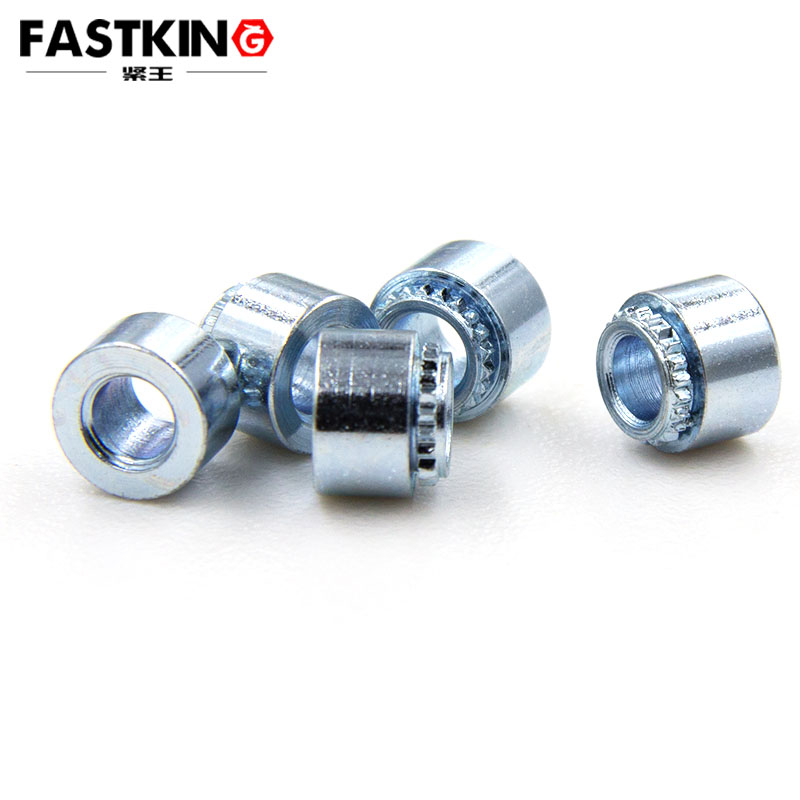
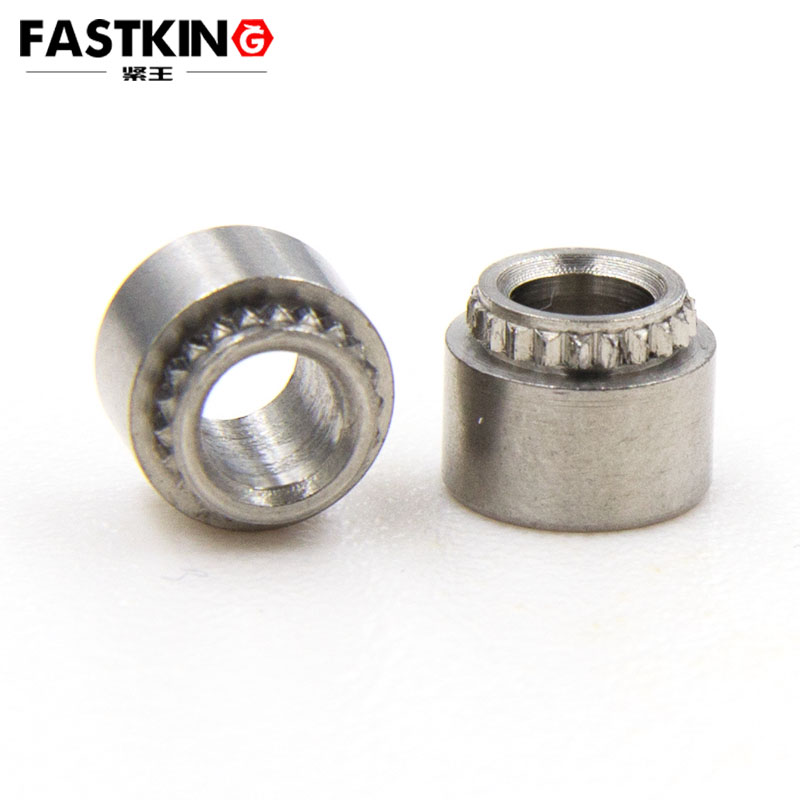
As a specialized fastener in the industrial assembly field, the hardened galvanized flanged self-clinching nut (toothless type) demonstrates excellent ada
From the perspective of product structure and core processes, the design of the hardened galvanized flanged self-clinching nut (toothless type) is full of industrial ingenuity, with every detail centered on the core demand of "adapting to blind installation and ensuring secure fastening". The "hardening" process is the key to its strength guarantee. Through quenching and tempering hardening treatment on the nut body, its Brinell hardness reaches the industry standard range of 220-250HB, enabling it to withstand large installation pressure and working load, and avoiding deformation or fracture of the body during the self-clinching process. It is particularly suitable for the fastening needs of base materials such as steel plates and aluminum alloys. The "galvanizing" treatment focuses on improving corrosion resistance. Using hot-dip galvanizing or electroplating process, a uniform and dense zinc layer is formed on the surface of the nut, which can effectively isolate the erosion of air, moisture, and acid-base media. Even when used in harsh environments such as outdoors, humidity, or chemical industry, it can significantly reduce the risk of rust and ensure the stability of the fastening structure.
The combination of the "flanged self-clinching" structure and the "toothless design" is the core highlight that distinguishes this product from traditional fasteners, and it is also the key to its adaptability to blind installation scenarios. Traditional threaded rivet nuts rely on the cooperation between threads and connectors to achieve fastening, while the toothless design forms a tight mechanical engagement with the base material through the plastic deformation of the nut body during the self-clinching process. It does not require auxiliary operation on the other side, perfectly solving the fastening problem in one-sided accessible scenarios such as blind holes and closed cavities. The flanged structure further optimizes the fastening effect. During the self-clinching process, the flange at the bottom of the nut undergoes plastic expansion under pressure, forming a larger contact surface with the base material surface. This not only improves the stability and load-bearing capacity of the connection but also disperses pressure, avoiding damage to the local base material due to concentrated stress. In addition, the flanged design also has a certain sealing and protective effect, which can reduce impurities and moisture entering the installation hole, forming additional protection for the connection between the base material and the nut.
In terms of application scenarios, relying on its unique performance advantages, the hardened galvanized flanged self-clinching nut (toothless type) is widely used in various fields such as automotive manufacturing, electronic appliances, medical devices, rail transit, and general machinery. In the field of automotive manufacturing, it is widely used in the assembly of auto body sheet metal, door interior panels, instrument panel frames, and chassis components. Especially in blind hole positions such as the auto body interlayer and bumper interior, installation can be completed without disassembling other components, greatly improving assembly efficiency. At the same time, its hardened galvanizing performance can cope with complex working conditions such as vibration and humidity during vehicle operation. In the field of electronic appliances, it is suitable for the fastening of the outer casings and internal structures of home appliances such as printers, air conditioners, and washing machines. The toothless design can avoid scratch damage to precision components such as wires and circuit boards, and the stable fastening performance of flanged self-clinching can ensure that the components of home appliances will not loosen during long-term use.
In the field of medical devices, due to its high stability after hardening treatment and the corrosion resistance of the galvanizing process, this product is used for the frame fastening of medical equipment, meeting the strict requirements of medical environments for hygiene and reliability. In the field of rail transit, it is suitable for the installation of carriage interior decorations, seat brackets, and other components, and can withstand high-frequency vibrations during carriage operation to ensure long-term stability of the connection structure. In addition, in outdoor use scenarios such as containers, outdoor amusement facilities, and building curtain walls, the corrosion resistance of its zinc layer can effectively extend the product's service life and reduce later maintenance costs.