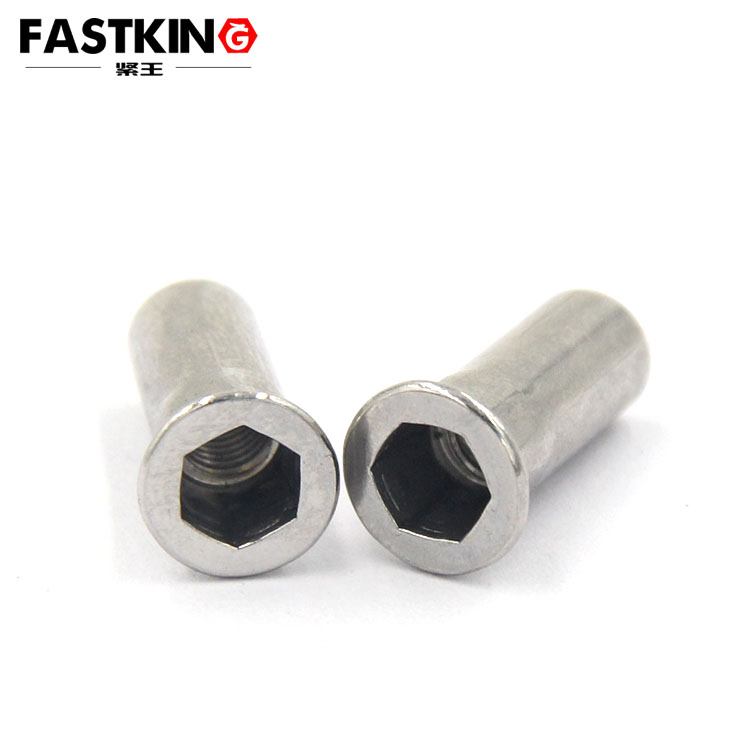
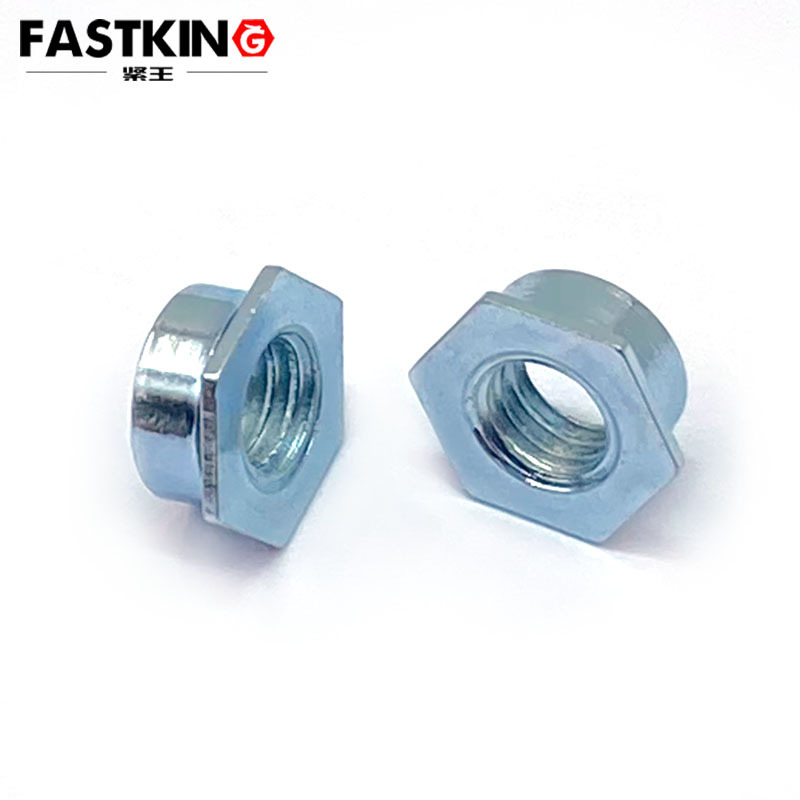
In numerous fields such as mechanical manufacturing, automotive assembly, aerospace, and electronic equipment production, fastening connection is a crucial link ensuring product structural stability and service life. Particularly in blind hole scenarios where only one side is accessible and the other side cannot be operated, traditional fastening components often find themselves helpless due to limited operating space. The emergence of internal-external hexagon blind rivet nuts has completely broken through this technical bottleneck. With their unique design integrating both internal and external hexagon structures, excellent fastening performance, and wide scenario adaptability, they have become the all-around core components in the field of blind installation fastening, playing an irreplaceable role in precision assembly across various industries.
Internal-external hexagon blind rivet nuts, also known as internal-external hexagon blind-installed rivet nuts, are high-efficiency fasteners specifically tailored for blind hole environments. Their core advantage lies in the ability to complete installation from only one side of the workpiece, achieving reliable fastening without the need for auxiliary support on the other side. Structurally, they ingeniously combine the dual structural characteristics of internal and external hexagons, mainly consisting of a nut body, precision threaded hole, riveting flange, and anti-loosening threads. Some special models are also equipped with sealing washers, which can simultaneously meet multiple requirements such as fastening, anti-loosening, and sealing. Compared with ordinary blind rivet nuts, internal-external hexagon blind rivet nuts feature a more exquisite tail design, enabling stable riveting fixation in closed or semi-closed blind holes. They not only avoid the dependence of traditional bolt connections on operating space on both sides but also facilitate disassembly and assembly through the internal-external hexagon structure, greatly improving the efficiency of assembly and later maintenance.
Material selection is a key factor determining the performance limit of internal-external hexagon blind rivet nuts. Products made of different materials exhibit significant differences in mechanical strength, corrosion resistance, high-temperature resistance, and lightweight level, which can accurately meet the needs of different working environments. Currently, mainstream materials on the market include carbon steel, stainless steel, aluminum alloy, etc., among which 304 and 316 stainless steel are the most commonly used. Carbon steel internal-external hexagon blind rivet nuts have low cost and good mechanical strength, suitable for ordinary mechanical scenarios with low corrosion resistance requirements, such as fixing ordinary equipment frames. Products made of 304 and 316 stainless steel have excellent corrosion resistance and oxidation resistance, especially suitable for use in harsh environments such as humidity, acid, and alkali, and are widely used in marine equipment, chemical machinery, outdoor building curtain walls, and other fields. Aluminum alloy internal-external hexagon blind rivet nuts take lightweight as their core advantage and also have certain corrosion resistance, making them an ideal choice for fields with strict weight control such as aerospace and automotive manufacturing. In addition, for high-temperature working conditions, products made of high-temperature alloy materials are adopted to ensure stable fastening performance even in extreme temperature environments.
The application scenarios of internal-external hexagon blind rivet nuts almost cover all fields requiring blind installation fastening. Their flexible installation method, reliable fastening effect, and convenient disassembly and assembly characteristics have won wide favor in various industries. In the field of automotive manufacturing, they are widely used in the assembly of body frames, door interiors, instrument panels, and chassis components, especially in blind hole positions such as body interlayers and bumper interiors. They can not only effectively fix components but also avoid damage to the body appearance. Meanwhile, the internal-external hexagon structure facilitates later maintenance and disassembly. In the aerospace field, they are one of the core fasteners, used for connecting key parts such as aircraft fuselage skins, wing structures, and engine nacelles. Their characteristics of both lightweight and high strength perfectly meet the strict requirements of aviation equipment for safety and weight reduction. In the manufacturing of electronic equipment, such as the assembly of shells and internal components of mobile phones, computers, and precision instruments, internal-external hexagon blind rivet nuts can achieve precise fastening, ensuring the stability of equipment components without affecting the appearance neatness of the equipment. In addition, in fields such as medical devices, rail transit, and shipbuilding, they have also become the preferred components to replace traditional fastening methods by virtue of their unique advantages.
Correct installation operation is the premise to ensure the fastening effect of internal-external hexagon blind rivet nuts. The installation process mainly includes four core steps: drilling, reaming, inserting the nut, and riveting fixation, and each link needs to strictly control details. Firstly, it is necessary to drill a blind hole of appropriate size on the workpiece according to the nut specification to ensure that the hole diameter matches the outer diameter of the nut accurately, avoiding loose riveting caused by excessive hole diameter or damage to the nut due to too small hole diameter. Secondly, ream the port of the blind hole to provide sufficient space for the flange of the nut and ensure the fit after riveting. Then, smoothly insert the internal-external hexagon blind rivet nut into the blind hole to ensure that the nut is completely attached to the workpiece surface without inclination or deviation. Finally, use a special riveting tool to operate, and the tail of the nut undergoes plastic deformation through the pulling force of the tool to form a firm flange, thereby firmly fixing the nut on the workpiece. During installation, it is necessary to control the riveting force properly; excessive force may cause damage to the workpiece or deformation of the nut, while insufficient force cannot achieve reliable fastening. At the same time, it is necessary to ensure that the inside of the blind hole is clean without impurities and oil stains to avoid affecting the fit and fastening effect.
As a key component in the field of blind installation fastening, internal-external hexagon blind rivet nuts provide efficient solutions for precision assembly in various industries with their unique structural design, diverse material selection, and wide scenario adaptability. With the development of mechanical manufacturing, aerospace, and other industries towards high precision, lightweight, and intelligence, internal-external hexagon blind rivet nuts will also continue to iterate and upgrade, achieving breakthroughs in material optimization, structural innovation, and performance improvement, and continuously providing support for the high-quality development of industrial production.